Tuesday, July 6, 2010

The Navy Reveals Secret Device to Defeat IEDs

http://www.popularmechanics.com/technology/military/news/navy-reveals-secret-device-to-destroy-ieds

Last week the Pentagon revealed the existence of a new weapon in the war against roadside bombs: a beam of radio-frequency energy that can detonate hidden Improvised Explosive Devices (IEDs) at a distance.

And its creators say the potential does not stop there—the beam could be also used to set off other types of warheads before they reached their target. In theory it might be used to set off ammunition before the enemy even has a chance to fire. "The capabilities are not limited to improvised devices," Lee Mastroianni, program manager at the Office of Naval Research (ONR), told Popular Mechanics


it's much needed, thats for sure

Sunday, July 4, 2010

Marom Dolphin Special Forces Combatant Vest


http://www.zahal.org/

The Marom-Dolphin Special Forces Combatant Vest is specifically designed to meet the needs of the IDF in the 21st century, it can be used in urban, woodland and desert conditions. Constantly improved after the Second Lebanon War this is the most battle tested product we can offer.


4 front lower pouches hold 3 rifle mags (M16/AK 47/Galil) per pouch-(total of 12 rifle mags).
4 single pistol mag pouches 1 on each side of rifle mag pouches.
3 front upper pouches holds grenades -flares-radio.
Map or radio codes compartment
1 front left pouch holds flashlight.
2-front right pouches holds first-aid, grenades, flares or 4 pistol mag pouches.
Top rear pouch with internal pouch holds complete radio system or first aid or other gear.
Passage for communication device wires, antenna or water vessel.
2 rear pouchs hold water canteens (not included).
Lower rear pouch, holds rope-gear.
External elastic strap for helmet.
Padded adjustable shoulders for perfect height.
High quality velcro closures and quick release snaps.
Side adjustable straps to adjust girth for a perfect fit.

Price: $225.00
AMERICA FUCK YEAH

Thursday, July 1, 2010

programmable matter (Transformers)

Pentagon scientists working with MIT and Harvard researchers have developed a paper-thin shape-shifting structure capable of transforming into a toy boat or a paper plane by itself. This development is of course the first step towards real-life Transformers.


The system is the result of DARPA research kicked off in 2007 to investigate the possibilities of creating programmable matter capable of forming everything from a wrench to body armor. This is the first result from the work, a kind of programmable origami made from stiff polymer tiles and 25 thin foil actuators. In function, a programmer creates the desired three-dimensional shape, the system analyzes the shape, determines the steps necessary to get there, and proceeds to fold up on its own. Researches hope to use this kind of technology to develop better armor, on-site replacement parts, and vehicles which can adapt to an environment on the fly. One day they hope to be able to create an amorphous material without such joints, more of a fluid which mold itself into any kind of shape on command


Wednesday, June 30, 2010

Saudi king wants advanced F-15s to counter 'Iranian threat'


http://www.worldtribune.com/worldtri...0587_06_29.asp

Saudi king to press Obama for advanced F-15s to counter 'Iranian threat'

WASHINGTON — Saudi Arabia has submitted an urgent request for advanced F-15 fighter-jets from the United States

Officials said the Saudi request would be discussed during King Abdullah's meeting with President Barack Obama on June 29. They said the 86-year-old king was expected to sign an agreement in principle to purchase the F-15s in a deal estimated at nearly $10 billion.

Officials said the Saudi royal family has relayed a request for 72 F-15s, manufactured by Boeing. They said the F-15s would comprise the most advanced models, including stealth platforms.

"This has been high on the Saudi agenda," an official said. "The Saudis want these planes quickly."

"The deal would also include Saudi financing of a stealth F-15," the official said. "Right now, the U.S. Air Force is not interested in such a plane."

Officials said Abdullah has demanded the rapid implementation of U.S. weapons deals. They acknowledged that the Defense Department, amid the wars in Afghanistan and Iraq, has been mired in huge delays regarding the delivery of more than $10 billion in Saudi weapons orders.

"The Saudis want to buy [American warplanes], but they won't tolerate delays," the official said. "They have reminded us that they could turn to Europe and get advanced aircraft within three years of a contract.


Saudis want F-15 Silent Eagle badly and is willing to finance its development so that they could get the first plane within 3 years.


"Saudis want F-15 Silent Eagle badly and is willing to finance its development so that they could get the first plane within 3 years." so i guessing they are getting ready for when the SHTF, experts say iran could possibly have a nuke in 3-5 years which is why they want them with in the next 3 years

Thursday, June 24, 2010

Springfield Armory SOCOM II


Springfield's SOCOM 16 is the shortened version of its M1A that was built by military request. The 16-inch-barreled .308 sports a four-inch MIL-STD 1913 rail attached about 8 3/4 inches behind the front sight to accept a long-eye-relief scope, making the gun suitable for either close-quarters combat or long-range engagements, but according to some, a shortcoming of the SOCOM is the lack of rails for attaching accessories.

In response, Springfield developed the SOCOM II. One version has a MIL-STD 1913 rail running along the top of the barrel from the front of the receiver to just 2 1/4 inches behind the front sight. Another version extends the rail to the rear of the receiver and can accommodate a scope with standard eye relief. Springfield then adds rails to the bottom and both sides of the fore-end. The rail system can be removed in a matter of seconds by retracting two spring-loaded latches, revealing the standard fiberglass stock available in either black or Urban Camo. I received the Extended Cluster Rail version for testing.


The SOCOM II action is identical to the M14, using a gas piston and rotating bolt, except that a muzzle brake has been added. It sounds easy to shorten a rifle, but just lopping off the end of the barrel reduces gas pressure and affects functioning, so the muzzle brake, which also acts as a pressure chamber, was added to ensure proper cycling


The rear sight is a military aperture that is fully adjustable for elevation and windage and moves the point of impact one minute of angle per click. At the other end, protected by sturdy wings, is a post front sight with tritium insert to aid in low light. The gun accepts any M14 magazine. The test gun's two-stage military trigger broke at six pounds, two ounces.


Immediately after receiving the test gun, I contacted Vltor Weapon Systems for its recently developed M14 Modstock, which sports a buttstock that is adjustable for both height and length of pull, a quick-detachable sling swivel on both sides and a pistol grip made by Tango Down. I added a Surefire Model 900 combat light with its own vertical foregrip, a Wilderness Single Point Sling, an Aimpoint Comp M3 with two-MOA dot combat optic and an Aimpoint 3XMag magnifier.

So how did it shoot? Well, off the bench at 50 yards the best group average was 1.2 inches with Hornady 155-grain TAP, but all ammunition used performed well within acceptable limits.

This gun has an effective range of 300 to 400 yards, perhaps more depending on the aiming device and the ability of the shooter. At the Scottsdale Gun Club, I conducted close-quarter combat drills consisting of quickly acquiring and shooting targets at ranges from three to 25 yards and found the SOCOM II to be fast, accurate and easy to aim.


IMPORTER: Springfield Armory
TYPE: Gas-operated semiauto
CALIBER: .308
CAPACITY: 5, 10, 20 possibly 30
WEIGHT (oz.): 10 3/4
SIGHTS: Aperture rear, tritium post front
PRICE: $2,006

m14 EBR pretty much the same thing

Friday, June 18, 2010

BAE Systems Anti-Aircraft Missile Jammer

By Joe Pappalardo


new device, called Boldstroke, is the solution to a problem the Army does not want to have: the threat of advanced shoulder-fired missiles to American helicopters


There's a laser-guided antiaircraft missile jammer sitting on the table of the conference room in the office of Popular Mechanics. It comes in a medium-size box, weighing in at about 30 pounds, topped with a clear hemisphere housing a prominent mirror mounted on a 360-degree gimbal. Peering inside the dome, a viewer can see a network of other mirrors that bounce light from a laser housed below, directing the beam to the main lens affixed to the gimbal. This prototype is the only one in the world, and this is the first time its inventors, BAE Systems, have brought it out of the lab for a journalist to paw over.

The device, called Boldstroke, is the solution to a problem the Army does not want to have. The threat of advanced shoulder-fired missiles to American helicopters is a nightmare, one that hearkens to the defeat of the Soviet Union in Afghanistan, where U.S. supplied Stinger missiles downed an estimated 250 Russian helicopters over two years. Shoulder-fired missiles with infrared tracking can rightfully take their place next to improvised explosive devices, sniper rifles and car bombs as gold-standard tools of asymmetric warfare.

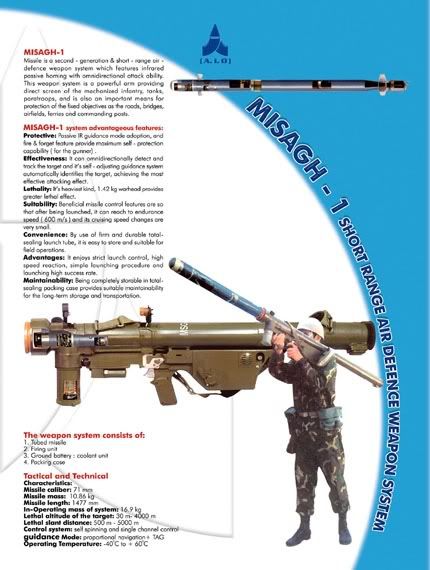
Insurgents in Iraq have used SA-7s, shoulder-fired missiles tipped with infrared homing devices, against U.S. and British aircraft. But there are more sophisticated threats out there, like the SA-16, which has a sensitive seeker that adds ultraviolet tracking to IR seekers in order to ignore flares that aircraft fire to spoof the missiles. The SA-16 is available on the black market.


sa-16 Pictures, Images and Photos
In 2008, something happened that triggered an increase in helo protection, and the Army commissioned BAE to fast-track a system that uses lasers to blind the seekers in infrared missiles. Exactly what prompted the request, called a Quick Reaction Contract, is classified. But it's not a leap to assume that intelligence reports or an actual attack set the wheels in motion. By the end of 2009 BAE delivered its first Advanced Threat Infrared Countermeasure (ATRICM) to the Army for use on its CH-47 Chinooks. ATRICM fires a pencil-thin multiband laser at frequencies that blind IR seekers scanning for targets in those same frequencies. The Pentagon recently confirmed to Aviation Week that the defensive system thwarted an IR missile attack on a Chinook, and BAE officials tell PM that the attack occurred within weeks of weeks of ATIRM's arrival in Iraq. The Army is on track to outfit its fleet of Chinooks in Iraq and Afghanistan with the protective system by the end of the year.

Helicopters are a deciding factor in both Iraq and Afghanistan—more so in Afghanistan, where roads are lacking and helos are used for resupply as well as combat missions. The crucial rotorcraft that ferries troops and supplies is the Chinook, but they depend on massive engines to haul their heavy loads. Those engines produce a lot of heat, enough to attract the attention of even modest missile seekers. “There is a huge IR signature from Chinooks,” says Ernest Keirstead, the director of BAE's Boldstroke program.

That brings us back to the prototype on the conference-room table. BAE has created Boldstroke to improve on ATIRCM. It's lighter, has fewer moving optical parts and uses mirrors instead of a physical “light pipe” to shoot its laser. Instead of three boxes, the entire unit is housed in one box. A helicopter with a Boldstroke system mounted on either side of the helicopter would have 360 degrees of protection. And the 360 gimbaled mirror is an improvement on the two-axis steering of the currently deployed ATIRCM.

The Boldstroke rollout is coinciding as simple, unguided rocket-propelled grenades (RPGs) continue to take their toll on helicopters during takeoff and landing. In early June a NATO helicopter was felled by a pair of RPGs, killing four soldiers. It is not the first such successful attack. BAE officials say they have dedicated money in-house to investigating how to modify current detection systems that could warn pilots of the approach of an RPG. The key, again, is heat from the rocket, which could be tracked by BAE's existing thermal sensors. Instead of a laser countermeasure, the system could warn pilot where the missile is coming from and allow for some evasive action.

BAE has sunk $70 million over the last three years on upgrading its lab and production infrastructure at its Nashua, N.H., facilities. They are betting—with good reason—that more work will come their way as IR missile threats proliferate. That could mean deploying similar systems on commercial airplanes as well as a wider variety of military aircraft

Wednesday, June 16, 2010

UAE Rafale Talks Moving Ahead: French Minister


PARIS - Technical talks on the sale of Rafale fighters to the United Arab Emirates are wrapping up, Defense Minister Herve Morin said June 15, adding that France was likely to pick up part of modernization costs.

Regarding the improvements that the UAE is seeking to the multi-role aircraft, Morin said on France Info radio "that's a discussion we've been engaged in for months and which is in the course of being finalized


Talks on acquiring the latest-generation French-made fighters began after the UAE expressed interest in 2008 in replacing its 60 aging Mirage fighters.


The Rafale, made by Dassault, has yet to clinch a single overseas sale and is in competition with Sweden's Gripen NG by Saab and the F/A-18 Super Hornet manufactured by U.S. giant Boeing.

The deal for 36 fighter planes is estimated to be worth between four and seven billion dollars, depending on details of armaments, maintenance and peripheral industrial involvement.

Turkey To Buy 9 European A129 Attack Helicopters


ANKARA - Turkey will launch urgent talks to buy nine A129 Mangusta attack helicopters from the Italian-British manufacturer AgustaWestland to fight separatist Kurds operating in an area near the country's borders with Iraq and Iran, a key Turkish official announced late Tuesday

Monday, June 14, 2010

F-35 Lightning II Intelligent Laser System

Not your typical paint job. The F-35 Lightning II is the most advanced combat aircraft ever built. Cutting edge technologies, including robotics, are used in it's manufacturing. Even painting the aircraft with radar-evading coatings is accomplished with precise instrumentation guided by lasers.


LinkWithin

Related Posts with Thumbnails